Why Is Everything Being Called Kimchi now?
On fermentation, gut health, and why names still matter
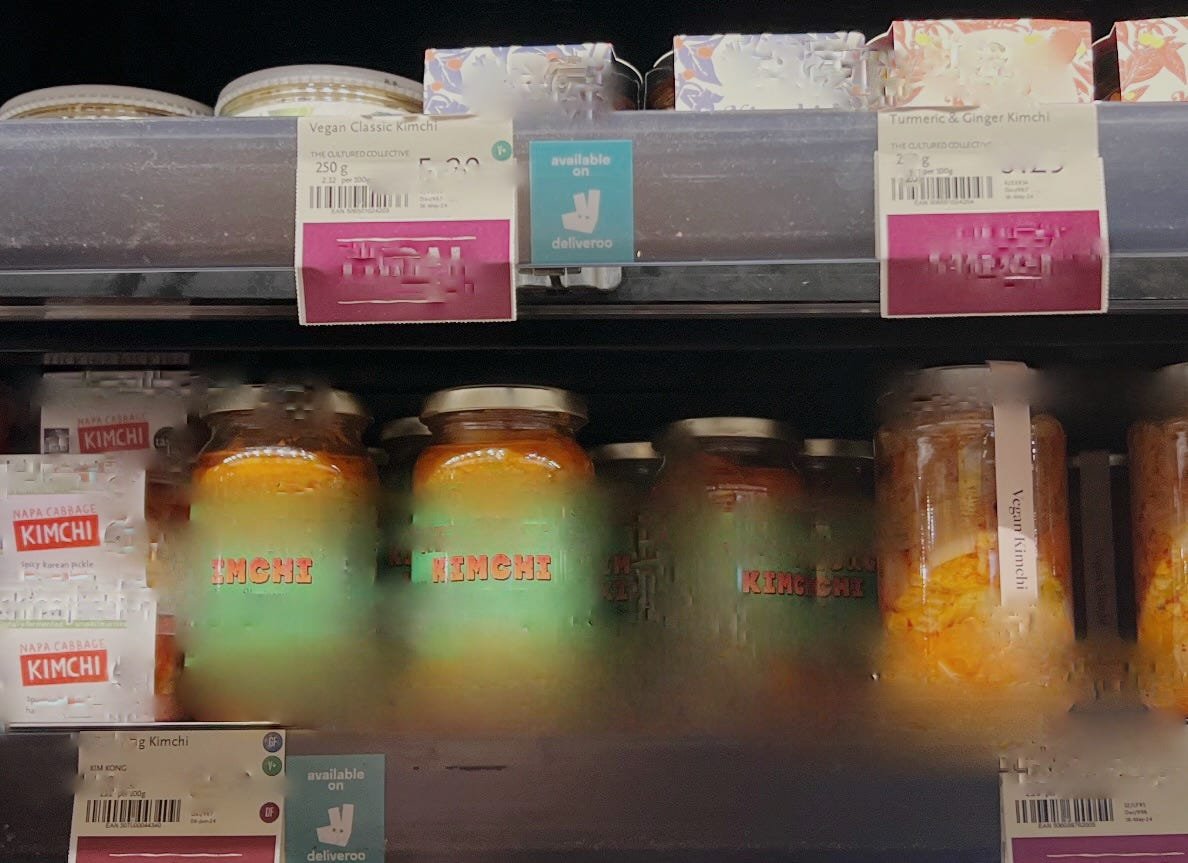
Why do so many different products carry the same name: kimchi? These images illustrate a broader retail trend, not any individual brand.
Kimchi is everywhere in the UK right now.
It appears in premium supermarkets, on cafe menus, in fermentation workshops, and throughout wellness culture. I don’t resent this. I’m genuinely glad when people discover kimchi.
What unsettles me isn’t kimchi’s popularity.
It’s the way the word kimchi is being used so loosely that it’s starting to lose its meaning.
More and more often, I see self proclaimed fermentation or probiotic experts proudly teaching “kimchi” that is, in practice, sauerkraut. Vegetables are salted at two percent, massaged until liquid is released, mixed with chilli flakes, garlic, ginger, sometimes miso ( Japanese ingredients) then pushed fully under brine and left to ferment.
It might taste good. It might be healthy.
But I keep asking the same question: why is this called kimchi?
Is it because Chinese cabbage is used, in any form?
Because chilli powder is present, whether generic or Korean gochugaru?
Because it looks red?
Kimchi is not defined by colour or ingredients alone. It is defined by method.
Kimchi is a paste fermented food, not a brine-submerged one like sauerkraut. After salting, the vegetables are rinsed in cold running water, drained, then coated in a seasoning paste and packed to ferment. They are not massaged to extract juice, and they are not designed to sit fully submerged in liquid.
If this were called a spicy, lacto-fermented cabbage pickle, the description would be accurate. But calling it kimchi while using a sauerkraut framework misrepresents what kimchi actually is.
Kimchi Is Not Just a Flavour Profile
Kimchi is not simply “spicy fermented vegetables.”
It isn’t any vegetable ferment with chilli added, and it isn’t interchangeable with sauerkraut.
Kimchi has a structure. It follows a clear process: salting or soaking, rinsing, drainage, seasoning with a paste, then fermenting through stages. It’s what gives kimchi its layered aroma, its evolving flavour, and its ability to move from fresh to ripened to aged without collapsing into a single note of sourness.
Paste fermentation is central to kimchi.
Kimchi does not rely on full brine submersion in the way many Western ferments do. Its logic is different. Its microbial environment is different. Its relationship to time is different.
When that structure is removed, the result may still be a successful ferment. But it is no longer kimchi.
Why This Is Happening Now
The post-COVID obsession with gut health explains a lot.
People didn’t suddenly discover digestion. They were shaken. They started looking for things they could control: routines, habits, food, forms of DIY health. Fermented foods were packaged as a simple promise. Fermentation equals probiotics. Probiotics equal health.
Within that narrative, kimchi became especially attractive. It’s bold. It’s visually striking. It carries cultural depth. Compared to sauerkraut, it feels more exciting, more exotic, more premium.
For wellness educators and fermentation instructors, kimchi offers cultural richness without requiring deep engagement with Korean food systems. It becomes a flavour variation rather than a food with its own internal logic.
When Kimchi Travels, Change Is Natural - Erasure Is Not
I understand that when kimchi travels, it changes.
Every food does. Korean food has always adapted as it moved across borders, kitchens, and generations.
But this is exactly why the North American context matters.
In North America, there are large, visible Korean and Korean American communities. Kimchi is not distant or inaccessible knowledge there. It is cooked, sold, written about, and taught by people with lived experience, family memory, and cultural continuity.
This makes the widespread mislabelling more difficult to justify.
If the knowledge exists, if the communities are present, and if correction is possible, then why is sauerkraut-style fermentation still being sold as kimchi?
Why not call it what it actually is?
Why not say Korean-inspired spicy pickles, spicy lacto-fermented vegetables, chilli-fermented cabbage, or even something playful like pink kimchi-style pickles?
The answer is uncomfortable but simple.
Because the word kimchi sells.
It carries cultural weight, recognisability, and perceived authenticity. Kimchi moves faster than “spicy fermented vegetables,” even when the process has little to do with kimchi’s actual method.
But accuracy does not make a food less delicious, less healthy, or less valuable.
It simply makes it honest.
Expertise Without Context Is Still Misinformation
I don’t believe most of these people are acting in bad faith. Some are genuinely enthusiastic. But enthusiasm does not replace responsibility.
When someone presents themselves as an expert, especially a scientific or probiotic authority, their framing carries weight. Students assume that what they are being taught is not only safe, but accurate.
I often hear defences like:
“This is a modern version.”
“Kimchi varies by region.”
“My method is more scientifically controlled.”
These statements are not wrong on their own. But they become evasive when the word kimchi is still used without explanation.
Variation does not mean anything goes.
Regional diversity does not erase core structure.
Scientific framing does not excuse cultural flattening.
If you use the word kimchi, you are making a claim. You are claiming a connection to a specific process, a fermentation logic, and a cultural context. That claim comes with responsibility.
This Is Not Gatekeeping
Let me be clear. I am not saying only Koreans can make kimchi. Anyone can learn to make it. Kimchi is not difficult.
But kimchi is not careless.
It requires attention, hands-on observation, and respect for how it works. Calling something kimchi while removing the very elements that make it kimchi is not inclusivity. It is mislabelling.
This is not about protecting purity.
It is about honesty.
Why the Name Matters
People often ask, “If it tastes good, why does the name matter?”
Because names teach.
When sauerkraut-style ferments are labelled as kimchi, the public learns the wrong thing. Kimchi becomes understood as just another brined vegetable ferment, rather than a distinct system with its own internal logic.
Over time, this flattens understanding. Korean food knowledge becomes filtered through Western fermentation frameworks and validated only when translated into probiotic language.
Ironically, this often happens under the banner of respect.
A Simple Solution
This does not need to be confrontational. It just needs clarity.
If you are teaching sauerkraut-style fermentation with Korean flavours, call it Korean-inspired ferment. Call it spicy pickled vegetables. Call it chilli-fermented cabbage.
All of these can be delicious. All can be healthy.
But if it is not kimchi, do not call it kimchi.
Accuracy is not gatekeeping.
It is the minimum responsibility of anyone who claims expertise.
How About “Modern Kimchi”?
If something truly builds on kimchi’s structure while adapting ingredients, context, or flavour, then call it what it is: modern kimchi.
Modern does not mean careless.
Modern does not mean unstructured.
And modern does not mean erasing the method that makes kimchi kimchi.
Modern kimchi can exist.
But only if we are honest about what we are modernising.
